The MVVM Pattern

The Model-View-View Model (MVVM) pattern is a common way of structuring a UI application. It uses a data binding system that helps move data between its view and view model parts. This means it achieves separation of application logic (view model) from the display of the UI (view).
Separation between the application logic and the business services (model) is commonly achieved by a Dependency Injection (DI) system.
MVVM might be overkill for a simple application; but as applications grow over time, they will often reach a point where keeping display definition and application logic in the same UI component modules becomes a problem:
- Interactions between UI components become complicated and error-prone.
- It becomes difficult to unit test UI components due to dependencies on the target UI platform.
MVVM solves this by abstracting the application logic into code-only classes that do not depend on the target UI platform, and can therefore be unit tested independently.
To discover more about the background to the MVVM pattern, see the Microsoft Patterns and Practices article here.
When to use MVVM?
MVVM is a more complex pattern of programming compared to the event-driven code-behind pattern. You have an additional learning overhead to master the techniques of the ReactiveUI framework which you will use to implement MVVM with Avalonia UI.
In fact, the code-behind pattern may well be easier for you to understand and maintain for a small simple application.
For details of how to program Avalonia UI with the code-behind pattern, see here.
The advantages of using the MVVM pattern may only become apparent when an application grows and becomes more complex. You therefore have two development strategies to consider:
- Start by using the simpler code-behind pattern. Aim to convert to MVVM should the application become difficult to maintain.
- Use MVVM from the start because you expect the application to grow.
The MVVM Model
The model is the other part of the MVVM pattern. Models are much less precisely defined in the pattern as they represent 'the rest of the architecture'. This is often data storage or other services.
The important principle for you to maintain is separation. You should implement the relationship between view model and model using some form of the Dependency Injection (DI) pattern.
Avalonia and MVVM
Views and View Models
When you use the MVVM pattern with Avalonia UI, you implement a view with an AXAML file, attached to a corresponding code-behind file, and a view model with a plain-old code class file.
In Avalonia UI, a view is implemented as a composition of UI elements in a window or a user control (both AXAML files with code-behind). The UI elements in a composition can be a mixture of Avalonia UI built-in controls, user controls and (more advanced) controls of your own design and implementation.
For a full list of the Avalonia UI built-in controls, see the reference section here.
To learn more about the concept of UI composition, see here.
To learn how to design and implement your own controls, see here.
Data Binding
Data binding is the key technology that allows an Avalonia UI MVVM application to separate views from view models. You can visualise the view to view model relationship as two layers connected by the data bindings:
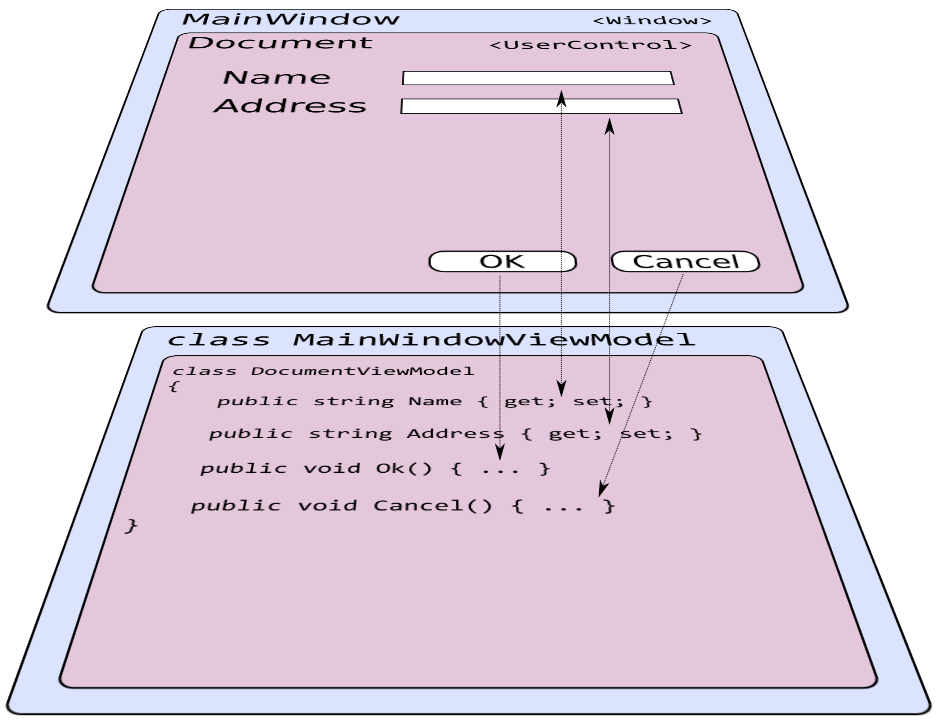
Notice how some of the data bindings are represented by a two way arrow and others by a single-headed arrow. For example, the name and address inputs are two ways - you want both changes in the view model to be notified to the view, and for inputs to the view to be updated on the view model.
The buttons however have one-direction commands, issued by the view and acted out by the view model.
Notice how the view model class is not dependent on the view layer, or how it will be rendered on the target platform by Avalonia UI. Because the view model class is independent, it can be unit tested like any other code.
When you use the MVVM pattern in practice, you will use a corresponding view model for each view, and the view model class contains all the application logic for the view.
ReactiveUI
There are a number of frameworks designed to help write applications using the MVVM pattern.
In the following pages, you will learn about the ReactiveUI framework which is one of the most popular and is supported by one of the Avalonia UI packages.
Have questions or feedback? Join the conversation below.